
Southeast Sicily represents one of Italy’s most captivating regions, where baroque architecture meets pristine coastlines and rich cultural heritage. This enchanting corner of Sicily invites travelers to explore its treasures at a leisurely pace, ideally by bicycle or on foot. From the UNESCO-listed baroque towns of Noto and Modica to the crystal-clear waters of Pozzallo and Marzamemi, the southeastern region offers diverse landscapes that change dramatically within short distances. Cycling through ancient fishing villages, past sprawling vineyards, and along dramatic coastlines provides an immersive experience that mainstream tourism simply cannot match. The region’s unique charm lies in its ability to showcase Sicily’s authentic character – a blend of Greek, Roman, Arab, and Spanish influences reflected in its architecture, cuisine, and traditions. For active travelers seeking meaningful connections with local culture while enjoying physical activity, Southeast Sicily delivers an unforgettable journey through one of the Mediterranean’s most fascinating territories.
The baroque treasures of Southeast Sicily
Southeast Sicily represents the perfect blend of natural beauty and human artistry. This corner of the Mediterranean island, known locally as “Sicilia Sud-Est,” boasts an extraordinary concentration of baroque architecture, a legacy of the massive rebuilding that followed a devastating earthquake. The Val di Noto region, comprising eight towns including Modica, Scicli, and Noto, is recognized as a UNESCO World Heritage site for its magnificent baroque buildings.
What makes this area truly special for active travelers is how these architectural wonders are nestled within diverse landscapes that transition from rolling hills to dramatic coastlines within just a few kilometers. Exploring by bicycle allows you to experience these transitions intimately, feeling the gradient changes beneath your wheels as you pedal from inland baroque towns toward the sparkling Mediterranean.
The region’s unique character emerges from layers of cultural influences. Greek, Roman, Arab, Norman, and Spanish occupations have all left their mark, creating a fascinating cultural mosaic visible in everything from building styles to culinary traditions. The baroque splendor you’ll encounter isn’t just about ornate facades and grand churches—it’s about how these elements interact with everyday life in small towns where locals still gather in piazzas and markets that have served as community centers for centuries.
Cycling through Modica and Scicli: baroque wonders and chocolate delights
Pedaling through the undulating landscapes of Southeast Sicily brings you to two extraordinary baroque gems: Modica and Scicli. These towns, built into steep-sided valleys, offer cyclists both challenges and rewards. The effort of climbing to Modica Alta is immediately compensated by breathtaking panoramic views from Pizzo Belvedere, where the entire city unfolds beneath you like an architectural masterpiece.
Modica, known as “the city of 100 churches,” presents a spectacular sight with its buildings cascading down the hillsides. The imposing Church of San Giovanni, accessible via a magnificent staircase, stands as a testament to baroque grandeur. But Modica offers more than visual delights—it’s renowned for its unique chocolate tradition. The “cioccolata di Modica”, produced using ancient Aztec methods introduced during Spanish rule, features a distinctive granular texture and intense flavor that differs markedly from conventional chocolate. Local chocolatiers still craft it by hand, often incorporating Sicilian ingredients like pistachios from Bronte or local citrus.
Just a short ride away, Scicli enchants visitors with its elegant town hall square and atmospheric streets. The town gained international recognition as a filming location for the popular “Inspector Montalbano” television series. Cycling between these towns takes you through the Iblei Valley with its characteristic dry stone walls and carob trees, offering moments of serene countryside between urban explorations. The relatively short distances between these baroque settlements make them perfect for day trips, allowing you to return to savor the evening atmosphere when the golden limestone buildings glow in the setting sun.
Coastal splendors: from Pozzallo to Marzamemi
The southeastern coastline of Sicily unfolds as a spectacular contrast to the inland baroque towns. Cycling from Pozzallo to Marzamemi takes you along a route where pristine beaches alternate with rocky coves and fishing harbors. Pozzallo welcomes cyclists with its Blue Flag beaches characterized by fine golden sand and crystal-clear waters—a perfect spot for a refreshing swim after a morning ride.
As you pedal northward along the coast, you’ll encounter the fascinating “Zona della Marza,” a series of wetlands including Pantani Cuba, Gariffi, and Longarini. These unique ecosystems serve as crucial rest stops for migratory birds traveling between Africa and Northern Europe. Birdwatchers might spot flamingos, herons, and numerous other species depending on the season. The coastal route occasionally veers inland through agricultural areas where tomato fields and almond orchards showcase the region’s agricultural bounty.
The journey culminates in Marzamemi, one of Sicily’s most picturesque fishing villages. Its charming Piazza Regina Margherita, surrounded by weathered stone buildings, epitomizes Mediterranean coastal beauty. The village’s history as a tuna processing center is evident in the former tonnara (tuna factory), now repurposed as restaurants and boutiques. Take time to explore the historic center before enjoying the day’s catch at one of the seaside restaurants. The local specialty, bottarga (cured fish roe), pairs perfectly with a glass of crisp local white wine as you watch fishing boats bobbing in the harbor. For cyclists, Marzamemi offers not just a destination but an authentic glimpse into Sicily’s maritime traditions and unhurried coastal lifestyle.
The southernmost point: Isola delle Correnti and Portopalo
Reaching the southernmost extremity of Sicily delivers a profound sense of accomplishment for cyclists exploring Southeast Sicily. The Isola delle Correnti marks not just the island’s southernmost point but also the fascinating meeting place of two seas—the Ionian and the Mediterranean. This small, rocky islet connected to the mainland by a narrow sandbar creates a natural phenomenon where you can clearly observe the currents from both seas converging and creating distinct water patterns and colors.
The lighthouse that stands sentinel on this windswept outpost offers spectacular panoramic views. On exceptionally clear days, the distant shores of North Africa might be visible on the horizon—a stark reminder that you’re standing at a historical crossroads of civilizations. The constant winds that sweep across this promontory have shaped not only the landscape but also the local way of life.
Just a few kilometers north, the fishing village of Portopalo di Capo Passero provides a charming stop with its pedestrianized center and the picturesque Piazza dei due Mari. From here, you can enjoy stunning views of the island of Portopalo di Capo Passero with its imposing fortress. The harbor area bustles with activity as fishermen unload their daily catch, much of which makes its way directly to the local restaurants.
For cyclists, this remote corner of Sicily offers both natural beauty and a sense of geographical significance. The relatively flat coastal terrain around Portopalo makes for easy riding, though be prepared for the region’s notorious winds that can either assist your journey or provide an additional challenge depending on your direction of travel. The effort is invariably rewarded with some of Sicily’s most spectacular coastal scenery and a true end-of-the-world feeling.
Noto: the golden city of Sicilian baroque
Noto stands as the crowning jewel of Sicilian baroque, a masterpiece of urban planning and architectural harmony that simply takes your breath away. Approaching the city by bicycle offers a dramatic reveal as the honey-colored limestone buildings gradually come into view, glowing golden in the Mediterranean sunlight. Unlike many historic towns that evolved organically over centuries, Noto was entirely rebuilt in a cohesive baroque style after the devastating earthquake, resulting in an exceptionally harmonious cityscape.
The heart of Noto unfolds along Corso Vittorio Emanuele, a spectacular promenade flanked by ornate palaces, churches, and civic buildings. The monumental staircase leading to the Cathedral of San Nicolò creates one of Sicily’s most impressive urban vistas. Take time to lock your bicycle and ascend these steps for a panoramic view of the city. Inside, the cathedral’s luminous interior demonstrates how baroque architecture manipulates light to create spiritual atmosphere.
Beyond the main thoroughfare, Noto rewards curious cyclists who venture into side streets with hidden architectural gems and artisanal workshops. The local specialty, granite (Sicilian sorbet), offers perfect refreshment after cycling, with almond and lemon varieties being particularly authentic to the region. For wine enthusiasts, the surrounding countryside produces excellent vintages, with several vineyards like Zisola welcoming visitors for tastings.
Cycling to Noto from the coastal areas involves some elevation gain, but the approach provides stunning views of the city on its plateau. The effort of the climb dissolves instantly upon reaching this living monument to human creativity and resilience. As evening approaches, the limestone takes on a magical amber glow, creating what many consider the most beautiful urban scene in all of Sicily.
Syracuse and Ortigia: where ancient history meets the Mediterranean
Syracuse represents the culmination of many cycling journeys through Southeast Sicily, offering an unparalleled blend of ancient history and Mediterranean beauty. Once the most powerful Greek city in the Mediterranean, rivaling even Athens, Syracuse now presents layers of civilization for visitors to explore. The archaeological park features an impressive Greek theater where classical plays are still performed against an ancient backdrop, and the mysterious Ear of Dionysius—a cave with remarkable acoustics.
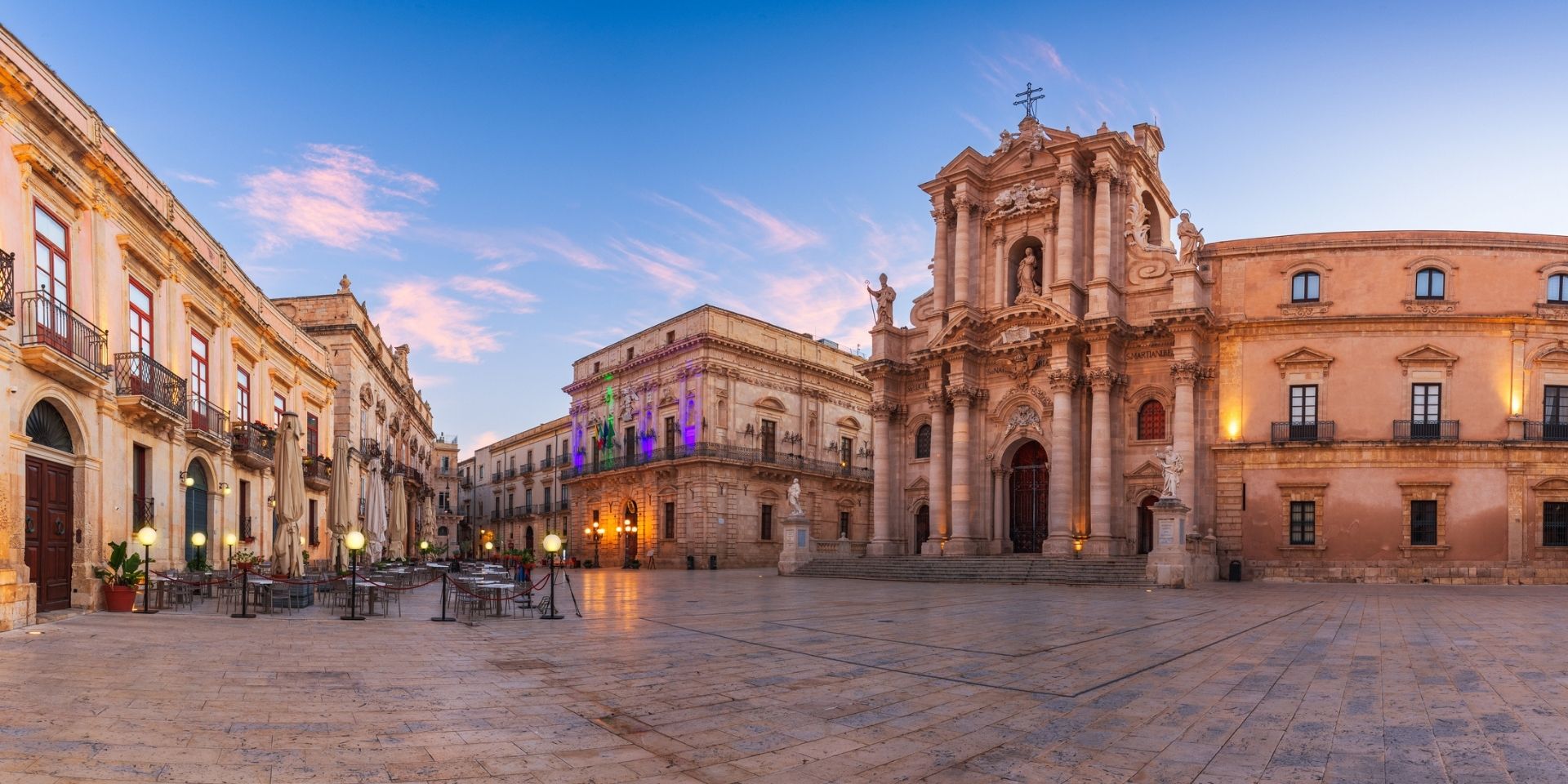
The true magic of Syracuse, however, lies in Ortigia—the small island that forms the city’s historic center. Connected to the mainland by short bridges, this compact peninsula is ideally explored on foot after securing your bicycle. Wandering through Ortigia’s maze of narrow medieval streets reveals unexpected squares, hidden courtyards, and buildings that span millennia of architectural styles. The magnificent Piazza del Duomo showcases one of Sicily’s most remarkable transformations: a Greek temple converted into a Christian cathedral, with Doric columns still visible within the baroque façade.
Don’t miss the vibrant market of Ortigia, where the colors and aromas of Sicilian produce create a feast for the senses. Fishmongers loudly advertise the day’s catch while vendors display mountains of sun-ripened tomatoes, fragrant citrus, and local specialties. This market represents the perfect opportunity to experience authentic Sicilian culture and perhaps pick up ingredients for a picnic by the sea.
The Fonte Aretusa—a freshwater spring that emerges just meters from the sea—offers a tranquil spot with its papyrus plants and legendary white ducks. From here, a pleasant promenade leads around Ortigia’s perimeter to the imposing Castello Maniace, providing stunning views across the Ionian Sea. As evening falls, the seafront restaurants come alive, offering the perfect setting to reflect on your Sicilian cycling adventure while sampling the island’s renowned seafood cuisine.
Practical tips for exploring Sicilia by bike
Cycling through Southeast Sicily rewards travelers with unforgettable experiences, but proper preparation ensures your journey runs smoothly. Here are essential tips to enhance your two-wheeled adventure through this baroque paradise:
- Optimal timing: Spring (April-June) and autumn (September-October) offer ideal cycling conditions with moderate temperatures and fewer tourists. Summer brings intense heat, making early morning departures essential if you visit during this season.
- Bicycle selection: Consider an e-bike if you’re concerned about the region’s hills, particularly around Modica and Noto. Ensure your bicycle has adequate gearing for climbs and reliable tires for occasional unpaved sections.
- Wind awareness: The region frequently experiences strong coastal winds, especially around Isola delle Correnti. Check wind forecasts and plan routes accordingly—a headwind can significantly increase cycling difficulty.
- Navigation essentials: While designated cycling routes exist, signage can sometimes be confusing or displaced. Carry detailed route descriptions and consider using GPS navigation as backup.
- Cultural timing: Remember the rhythm of Sicilian life includes the afternoon pause (typically 13:00-16:30) when many establishments close. Plan your cycling day accordingly, with major sightseeing in mornings and late afternoons.
Beyond these practical considerations, approach your journey with flexibility and openness. Some of the most magical moments in Southeast Sicily happen unexpectedly—a conversation with locals, a hidden viewpoint not mentioned in guidebooks, or a family-run trattoria serving generations-old recipes. The Sicilian approach to hospitality often means spontaneous encounters that become trip highlights.
For mechanical issues, local assistance is readily available in most towns, though carrying basic repair supplies is advisable. Most importantly, allow extra time in your itinerary for impromptu stops and explorations—the joy of cycling in Sicily comes not just from reaching destinations but from the discoveries along the way.
Experience the authentic Southeast Sicily with FunActive
Southeast Sicily offers a perfect blend of physical challenge, cultural immersion, and natural beauty that creates truly transformative travel experiences. From the golden baroque splendors of Noto to the ancient streets of Syracuse, from coastal villages to rolling countryside, this region rewards cyclists with a rich tapestry of sensations and discoveries. The varied terrain accommodates riders of all levels, while the authentic cultural encounters provide meaningful connections far beyond typical tourism.
Ready to experience the magic of Southeast Sicily on two wheels? FunActive Tours specializes in creating perfectly balanced cycling itineraries that showcase the region’s highlights while uncovering hidden gems known only to locals. Our expert guides, carefully selected accommodations, and comprehensive support services ensure you can focus entirely on enjoying the journey. Whether you prefer road cycling adventures through baroque towns or leisurely coastal routes with plenty of swimming opportunities, we have the perfect bike holiday waiting for you. Contact us today to begin planning your Sicilian cycling adventure!